An Expanded Deep Dive Into Why Consistency Is So Important
Consistency is the foundation of every successful training program. When you apply the same cues, rewards, and routines every day, your dog learns faster, feels more secure, and builds lasting habits that transform behavior for life.
Dogs thrive on predictable patterns. By structuring training sessions with clear, repeated signals and linking each lesson to the next, you’ll set your pup up for long-term success and deepen your bond in the process. This is about reshaping your dog’s neurological pathways through repetition, positive reinforcement, and structured engagement that creates calm, confident, well-adjusted companions.
The Science and Psychology Behind Repetition
Consistency provides clarity and security for your dog, two fundamental pillars that reduce anxiety and confusion while accelerating learning. Predictable routines help your pet understand what’s expected, which creates an environment where trust flourishes and behavior modification becomes sustainable.
According to the American Kennel Club, using the same words, tone, and body language every time you train ensures your dog knows exactly what you want, no matter the environment. Establishing routines around mealtimes, walks, and training sessions gives your dog a reliable schedule, improving focus and behavior at home while reducing stress-related cortisol levels.
The Neurological Impact of Consistent Training
Neuroplasticity, the brain’s ability to form new neural connections, explains why consistency is so powerful in dog training. Every time your dog repeats a desired behavior and you positively reinforce it, you encourage their brain to strengthen those specific neural connections. Over time, these connections become stronger and more established, leading to long-lasting behavior change that becomes automatic rather than effortful.
Research on canine learning demonstrates that dogs can form stimulus-reward associations in as few as 22 trials when training is consistent. Post-training activities like play can enhance memory consolidation, with studies showing that dogs who engaged in 30 minutes of play after learning retained skills significantly better even up to one year later.
This neurological foundation also explains why inconsistent training can be so damaging. When family members use different commands or timing, the brain struggles to solidify pathways, leading to confusion, slower learning, and even regression. Mixed signals prevent the formation of strong neural patterns, essentially forcing your dog to relearn behaviors repeatedly instead of building on established foundations.
Consistency Reduces Stress and Builds Confidence
Dogs rescued from neglect or abuse often come with anxiety and unpredictable behavior patterns. For these animals, consistency becomes the difference between chaos and calm. When feeding times, walks, and commands are predictable, stress hormones drop significantly, and training becomes a safe ritual instead of another unknown.Research published in scientific journals shows that structured schedules help regulate stress responses and lead to improved focus and behavior across all dog populations. Inconsistent handling, on the other hand, reinforces fear and uncertainty, making behavioral rehabilitation exponentially more difficult.
Core Elements of a Consistent Training Plan
Building a consistent training program requires attention to multiple interconnected elements that work together to create clarity for your dog. Each component reinforces the others, creating a comprehensive framework for learning.
1. Uniform Cues and Signals Across All Handlers
Every family member must use the same verbal cues and hand signals without exception. If “sit” means “sit” in the kitchen, it must also mean “sit” in the yard, at the park, and at the veterinarian’s office. This uniformity ensures your dog doesn’t become confused by varying interpretations of the same behavior.
Family consistency is critical! When one person says “down” and another says “lie down” for the same behavior, your dog experiences cognitive dissonance that slows learning dramatically. Create a family meeting to establish which exact words, hand signals, and body language everyone will use, then post a cheat sheet in a common area for reference.
2. Repetition Across Environments: Generalization Training
Proofing each behavior by practicing it in different settings and under varying distractions is essential for generalization. Begin training in a quiet room with minimal distractions, then progressively move to the backyard, front yard, neighborhood streets, and finally introduce public places like parks or pet stores.
This graduated exposure teaches your dog that commands apply universally, not just in controlled environments. Without this environmental diversity, you may find your dog responds perfectly at home but ignores you completely outside.
3. Reward Timing and Placement: The Critical Window
Correct timing is essential when using positive reinforcement. The reward must occur immediately, within one to two seconds, or your dog may not associate it with the proper action. This precise timing marks the exact behavior you want to reinforce, creating clear cause-and-effect relationships in your dog’s mind.
Mark correct behaviors immediately with a clicker or a verbal marker like “Yes!” and deliver the treat close to your dog’s nose to reinforce the connection between cue and action. As your dog becomes more reliable, transition to an intermittent reinforcement schedule where rewards become variable and unpredictable will actually strengthen behavior more than continuous rewards.
4. Daily Linking of Lessons: Progressive Skill Building
Build each day’s training onto the previous one in a logical progression. For example, once your dog reliably sits on cue, add duration (longer holds) before progressing to distance (walking away while they hold position), and finally introduce distractions (practicing in busy environments).
This progressive layering ensures your dog masters each component before adding complexity, preventing overwhelm and building confidence through achievable milestones. Create an internal linking structure in your training plan where each skill naturally flows into the next, much like the way you’d structure content on a website to guide users through related topics.
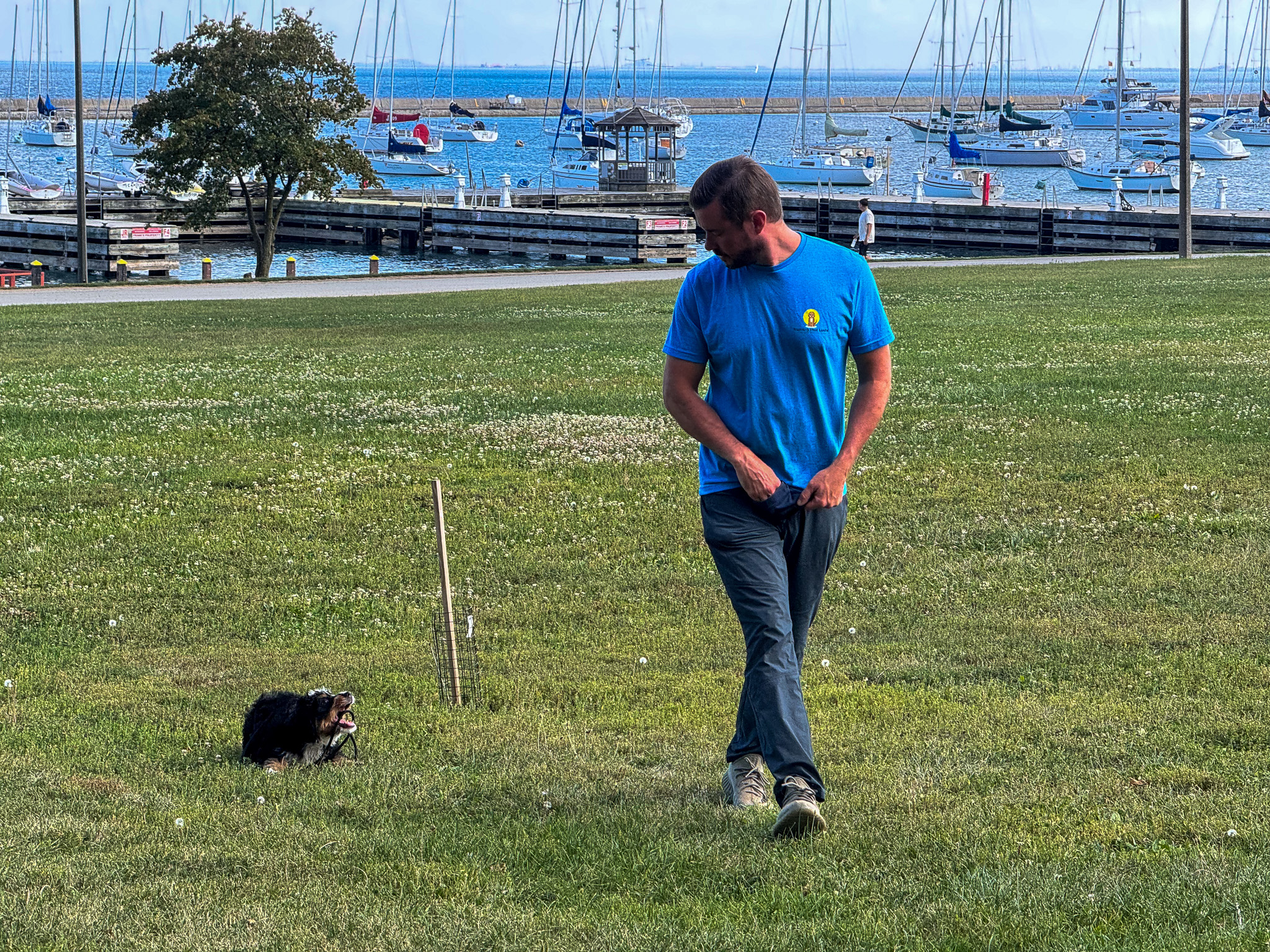
Today’s Advanced Training Session: Building a Reliable Sit Stay with Distractions
Building on yesterday’s foundation of basic sit-stay duration and distance, today’s session focuses on proofing the behavior under controlled distractions—the critical next step in creating a reliable command that works in real-world scenarios.
Objective: By the end of this 20-minute session, your dog will hold a sit-stay for 10 seconds while you introduce mild distractions, maintaining position without breaking focus.
Session Breakdown:
- Warm-up Review (3 minutes):
Practice yesterday’s 5-second sit-stay at one-pace distance in three different locations around your home. Reward each successful hold immediately. This reinforces the foundation before adding complexity. - Introducing Mild Distractions (7 minutes):
- Begin with your dog in a sit-stay position
- Gently wave your hand six inches to the side (not directly in front)
- If your dog maintains position, mark with “Yes!” and reward
- Gradually increase distraction level: shuffle your feet, sway slightly, or make soft mouth clicks
- Practice 5-6 repetitions, keeping successful holds at 80% or higher
- Environmental Distractions (6 minutes):
- Move the session to your backyard or a quiet outdoor space
- Ask for sit-stay while a family member walks by at 10 feet distance
- Progress to having them walk closer (8 feet, then 6 feet)
- If your dog breaks position, calmly reset without punishment and reduce the distraction level
- Duration Under Distraction (3 minutes):
- Combine elements: Ask for a 10-second sit-stay while you take two steps to the side and return
- Mark and reward heavily for success, this is challenging work!
- End session on a success to build confidence
- Cool-down and Reflection (1 minute):
- End with a brief recall game or a simple trick your dog loves
- Mentally note where your dog struggled so you can adjust tomorrow’s training
- Review our services page for additional structured support
Internal Resources & Next Steps: Building Your Training Journey
Consistency in training is just one piece of creating a well-balanced, obedient, and happy dog. To support your journey, explore these interconnected resources from Training That Lasts:
Foundation Building:
- Understanding how early consistency shapes lifelong behavior patterns
- The Importance of Connection and Communication – Building the relationship foundation that makes training effective
- Establishing In-Home Boundaries – Creating structure that supports consistent expectations
Specialized Training Programs:
- One-on-One Training Sessions – Personalized coaching to build handler skills and dog obedience
- Group Training Classes – Structured socialization combined with obedience in real-world environments
- Board and Train Programs – Immersive training with 24/7 consistency for faster transformation
Behavioral Support:
- Understanding Separation Anxiety – Applying consistency principles to anxiety reduction
- Consultation Assessment – Professional evaluation of your dog’s specific needs and challenges
Breeder Partnership:
- Trained Bernedoodle Puppies from Hoosier Canines – Starting with puppies who’ve experienced early neurological stimulation and consistent handling
Share This Article and Join Our Community
Consistency transforms more than just dog behavior,it strengthens families, builds confidence, and creates lifelong bonds between humans and their canine companions. If this article resonated with you, please share it with fellow dog owners who could benefit from these insights.
Connect with Training That Lasts:
- Follow us on social media for daily training tips and success stories
- Subscribe to our blog for the continuing series on consistency and skill building
- Contact us at 630-303-3545 for personalized training consultations
- Visit our About Us page to meet our training team
Stay consistent, stay patient, and your dog will reward you with reliable, confident behavior that lasts a lifetime. Training isn’t just about obedience, it’s about redefining relationships, one repetition at a time.