Your Dog Isn't Blowing You Off: They're Reading You
Your dog doesn't have a behavior problem. They have a clarity problem. Here's how to become the kind of leader your dog can actually read and follow.
You don't live with a "bad dog." You live with a dog who is getting a very clear education from you, just not always the education you meant to give.
At Training That Lasts, the core belief is simple: calm, collected, confident dogs start with calm, collected, confident humans who provide structure, communication, and follow-through. When a dog listens perfectly in training but falls apart at home, that's almost never a "stubborn dog" problem. It's a relationship and clarity problem.
This post is about fixing that gap in real life, in your kitchen, in your driveway, on your Tuesday-night walk after work, so your dog doesn't just "know it," they live it with you.
The Real Issue: Mixed Signals, Not Bad Behavior
Most owners who reach out aren't totally lost. Their dog usually knows sit, down, place, come. But the story sounds like this:
- "He sits… unless he's excited."
- "She comes… unless she's off leash."
- "He's great in class, but with me he just ignores it."
From the dog's point of view, that's not disobedience. That's data.
Dogs are professional pattern-readers. They notice when "sit" sometimes means "plant your butt now" and sometimes means "you can jump a few more times, I'll still pet you." They notice whether "come" actually matters the tenth time you shout it from the back door or whether you eventually shrug and let them keep sniffing.
Your dog's behavior is a reflection of the rules, patterns, and consequences they experience with you, not what you wish were happening. Understanding the importance of connection and communication is where this work really begins.
How Your Dog Is Quietly Studying You
Your dog is always tracking three things:
- Your words, the sounds coming out of your mouth.
- Your body, tension on the leash, how you stand, where you move.
- Your follow-through, what actually happens after they make a choice.
When those three don't match, dogs default to whatever has been most rewarding or least inconvenient for them in the past.
Example: You say "off" when your dog jumps, but you're laughing, your hands are on them, and then you push them down. From the dog's perspective, that's: jump, human makes fun noises, I get hands on me, zero consequence. That's a green light, not a correction.
Another example: You say "heel," then let your dog drag you to every smell, then randomly yank them back when you get annoyed. To your dog, that's chaos, not a rule. This is exactly why consistency is the cornerstone of real training progress.
"Your dog will always believe your patterns over your speeches."
Step One: Say It Once, Mean It, Help Them Succeed
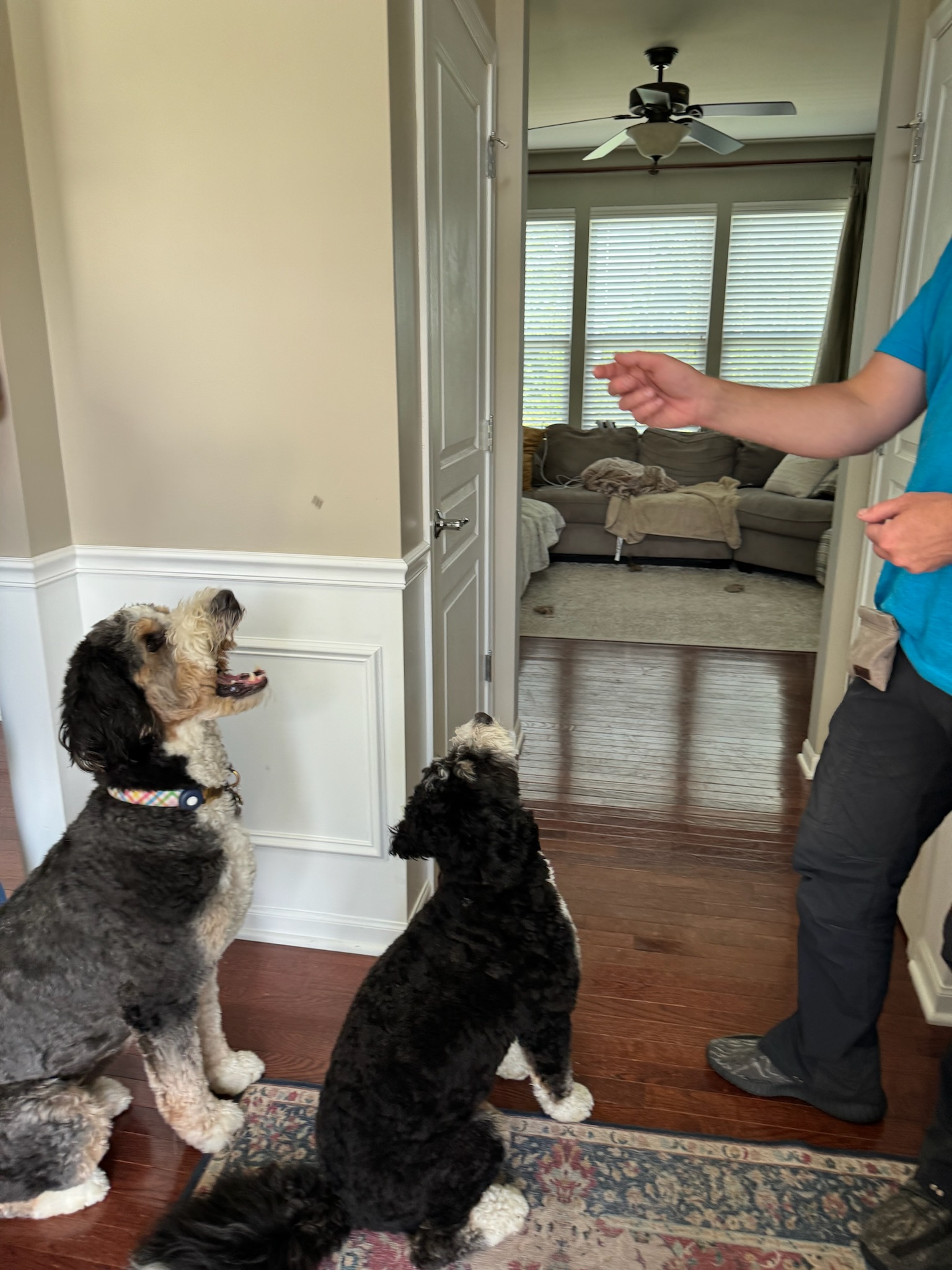
If your dog only obeys after the third or fourth cue, they've been trained to wait you out. Tonight, pick one behavior. Let's use "sit" at the front door.
- Walk to the door with your dog on leash. Stop, stand tall, leash relaxed.
- Say "Sit" once in a calm tone.
- Wait one full beat. Don't repeat, don't beg.
- If they don't sit, calmly help them into position. Gentle upward pressure on the collar, slight tuck on the rear if needed.
- When their butt hits the ground, then the door handle moves, then the walk happens.
You're teaching: the first word matters, I will calmly help you follow through, and the reward is the life activity you wanted anyway, going out the door. Do this every single time you go out for a week. Same word. Same rule. Same follow-through. That's structure, not a "training session."
Step Two: Make the Leash a Conversation, Not Background Noise
Most dogs are never really "on" leash. They're just dragging a human who's hanging on. A calmer, clearer pattern looks like this:
- Decide on a zone: your dog's shoulder even with your leg, or just slightly ahead, not out at the end of the leash.
- Start walking. If they pass the zone, don't argue. Simply stop. Plant your feet.
- Wait for slack. If they keep forging ahead, guide them back into position.
- As soon as they're back in the zone and the leash is loose, you move again.
You're turning the leash into a quiet language: tight leash means "that didn't work, come back and check in," loose leash means "now the walk continues." Ten minutes of this in your driveway is more valuable than a mile of getting yanked down the sidewalk. That's the whole idea behind structured walks (boring in the best way).
If you feel your shoulders creeping up to your ears, that's your cue to take a breath, lower your elbows, and reset. You're working on your leash skills just as much as your dog's.
Step Three: Your Nervous System Is the Real Tool
You can put an anxious, frustrated human on the other end of any leash tool and the dog will still be anxious and frustrated. The motto at Training That Lasts is about redefining the relationship, and that starts with you acting like the outcome is already handled, even when your dog is still learning.
Breathe before you act. Slow your movements. Talk less, move more. Your dog doesn't need a motivational speech. They need a steady human with a plan.
Dogs key off fast, jerky motion as "something's wrong." Slow, deliberate body language reads as "I've got this." And if your dog is blowing through your words, close distance, use the leash, guide them where they need to be. Quiet leadership beats loud commentary every time. This is something Tyler addresses hands-on during in-home training sessions, where your actual environment is part of the lesson.
Step Four: Fewer Rules, Stricter Consistency
Most owners either have a thousand soft rules, specifically: "sometimes he's allowed on the couch, sometimes not", or no rules until they're embarrassed, and then everything becomes an argument. Pick three non-negotiables for the next month. For example:
- No blasting through doors before humans.
- No jumping on people, ever.
- No charging the fence or window when someone passes.
Then lower the bar so your dog can actually win. For doors: they don't need a perfect competition sit, they just need to pause and wait for your release. For jumping: interrupt the first paw lift, not the full airborne collision. For the window: interrupt the first alert and send them to place, not after three minutes of barking.
Small, early, consistent interventions are what feel fair to dogs. Big, random explosions feel like lightning, scary and impossible to predict. Obedience training builds the vocabulary your dog needs so those interventions actually land.
Step Five: Be the Same Human on Tuesday as You Were on Sunday
This is where most training falls apart. Owners will be rock-solid for a weekend, then life gets busy. They're tired, the kids are loud, and suddenly the dog is back on the couch because it's "just tonight," "come" from the yard becomes "eh, he'll come in when he's ready," and loose leash turns back into "I'll just let him pull, I don't have the energy."
Dogs don't separate "training" from "real life." Every Tuesday decision is as educational as Sunday's structured session. If you want a calm, collected, confident dog, you don't need perfection. You need to stop undoing your own work:
- If you don't mean it, don't say it.
- If you say it, calmly see it through.
- If you're not going to enforce it today, be honest with yourself and don't pretend it's still a rule.
Your dog will always believe your patterns over your speeches.
When to Bring in a Trainer
Sometimes the gap between what you want to do and what you can realistically execute alone is just too big. That's where a good training program becomes less about "fixing the dog" and more about resetting the whole system.
Training That Lasts works with families in the Bristol, IL area and surrounding Chicagoland communities, blending real-world structure, leash work, and clear communication so owners can lead calmly and confidently at home. The programs don't stop at obedience. The focus is on behavior in the places it actually matters: your house, your neighborhood, busy public spaces.
Tyler also leans heavily on real-life outlets like group training and structured group walks to practice neutrality, handler focus, and calm around other dogs in a way that's guided, not chaotic. That kind of follow-through after a board-and-train or private sessions is often the difference between "He used to be good" and "This feels easy now."
If you're reading this and thinking, "My dog listens to the trainer, but not to me," that's not a failure. It's a sign that the relationship and patterns at home need to be rewritten. That's fixable, and it usually starts with you changing how you move, speak, and follow through long before anyone asks your dog to be "better."
Start with one door, one leash rule, and one non-negotiable today. Let your dog watch you become the calm, collected, confident leader they've been trying to decode this whole time.

Keep Reading
Ready to Rewrite the Relationship?
Tyler works with dogs and their owners across Yorkville, Oswego, Bristol, Naperville, and the greater Chicagoland area. Start with a free behavioral assessment and get a clear picture of what's actually going on.
Book Your Free Assessment